

There have been times, over these last few very stressful years, when I have found it hard to get myself to sit down and write. For most of my life I have been stuffed to the gills with feelings and ideas and excited about all the things I want to share, so this development has been quite shitty and unwelcome. It’s understandable, though. I think the fear and psychic torpor that’s been filling in around us like some noxious gas has been seeping into my mind and heart—but frankly I refuse to let that happen for long.
I have a few practices that see me through these difficult spells. One of them is making found poems. Most often I make them by paging through a book, noticing some of the words, and plucking them out by removing the others, thereby giving them a new context. It’s writing, but it’s also a kind of creative reuse. Let’s call it by its most magical possible name: divination. That makes it sound supernatural and mystical, and indeed it is. It’s also simple and accessible, crafty and fun.
To do the kind of divination I do—bibliomancy—all you need is a book that speaks to you, one you think will have something in it you can use. Traditionally the word bibliomancy refers to a type of fortune telling in which you ask a book a question, then let it fall open to a random page to find the answer. What I do is a bit different than that, but I consider it a form of divination just the same. I’ll find the book I want to use and, before I open it, I’ll bring some sort of intention to the project. I keep that intention in my mind as I scan the pages, and while I look, some of the words will seem more appealing, more possible, than others. Eventually those words will begin to swim together to form new sentences, tell new stories. I black out all the ones I don’t need with a thick Sharpie marker.
A few years ago I wanted to make some of these blackout poems, so I went over to a nearby Salvation Army and browsed their grubby bookcases. They always have good weird stuff there. I found two novels, both in hardback, that had belonged to the same woman, which I know because she pasted her address label on the inside front covers of them both. The books are by two different authors, but they’re both gothic-romance adventure stories published in 1976. One’s about an American jewel merchant living in Hong Kong, and the other is about a young couple who inherit an opal mine. I chose these novels because they’re exciting and a little bit scandalous, and therefore filled with juicy words: Love. Destroy. Dark. Glittering. Mocking. Wounded. Crimson. I knew I’d be able to make something good with words like these. I don’t think I really noticed until just now that both books are about people looking for precious gems, but that seems perfect now that I think of it.
More recently I used the same two books to make poems for a friend’s zine project. She asked people to write about what they conceive god to be, and divination seemed to me to be the most interesting, and frankly the most possible, way of approaching the idea. First I sat quietly for some hours, scanning the pages for the word god. I was a bit surprised to find it all over these overripe novels. People keep exclaiming things like, “Dear God!” or “By God!” or “God he was frustrating!” I flagged all the gods I could find, and later went back and made poems from those pages. It turned out to be a powerful way to put words to ideas I have often found unsayable.
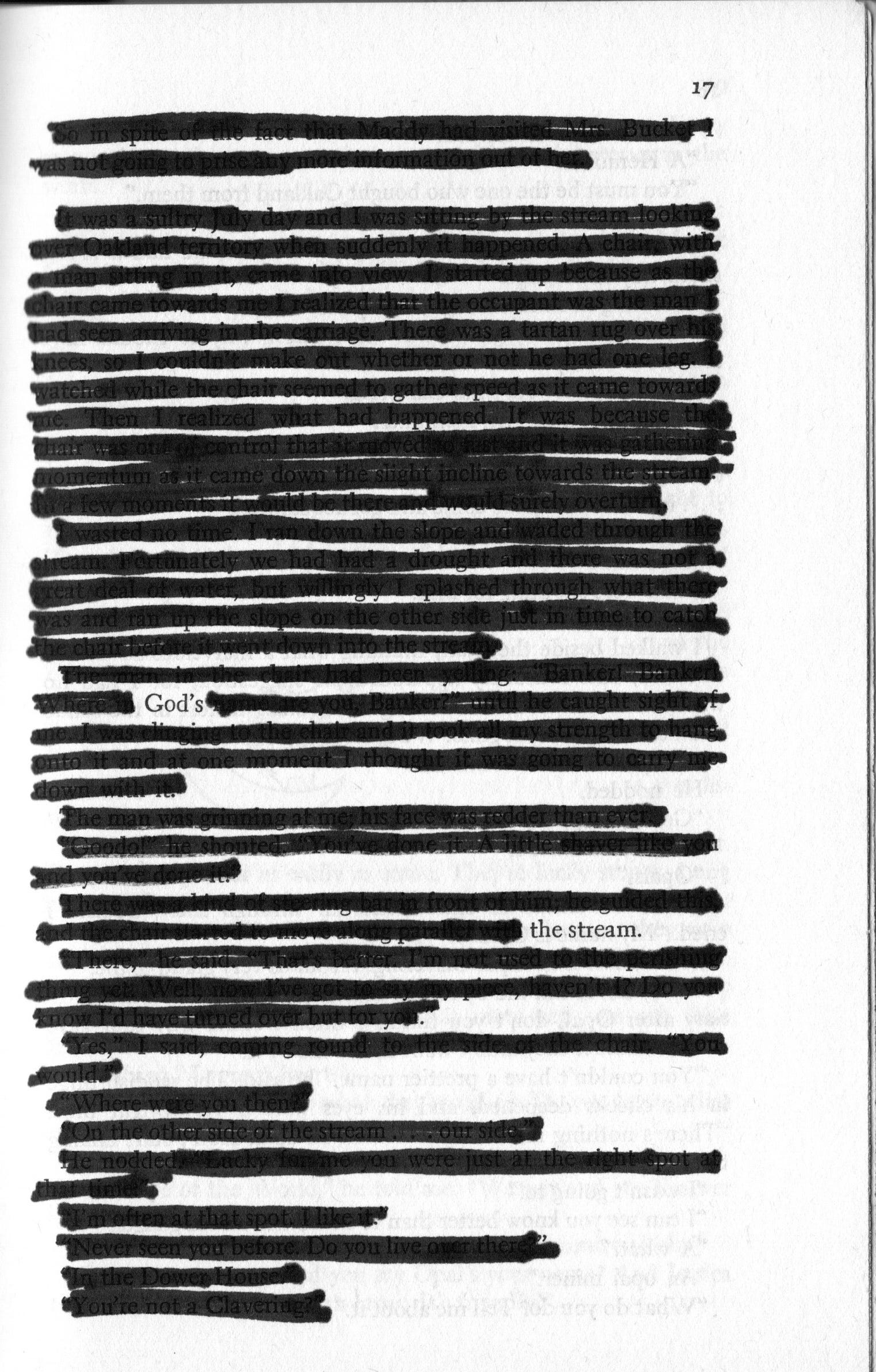
I sent a handful of the poems to my friend, and after that I kept returning to my stash of books and making more of them, since the project felt unfinished, and working on it felt good to do. I have a lot of them now. As I work on them, I catch myself picturing a room wallpapered from floor to ceiling with my pages: A looking-for-god room, mostly blacked out, with slivers of light peering through all around me.
Sometimes my process of divination comes easily to me, and other times it’s effortful, but it is always enlightening. I often find out something about the way I feel that I didn’t fully know before. The feeling is actually very similar to the surprise of discovery that happens during a more ordinary writing session, where you dig and dig until you strike something that’s alive inside of you.
In one way, making poems out of a limited selection of words is easier than starting from scratch, with that blank screen staring back at you. In another sense it takes an even bigger leap of faith. How can you make the poem you want to make when you don’t get to choose the words? You have to open your eyes and look, that’s how, and be willing to see what’s there. You have to be okay with not knowing what kind of poem you need to write in the first place. You have to stay the course, but remain open and flexible to whatever may come.
****
An earlier version of this piece of writing was taken “from the vaults” of my former Wordpress blog, which was also called Indicative Mood. It has been edited and updated.
I really dig the process you employ for these poems. I think having an intentional theme or concept prior to going through the book is a nice way to embrace and harness the randomness that ensues.
I'm led to think of the cut-up technique William Burroughs used to make his Dada-esque poems, as well as the paintings made by Tim Rollins and K.O.S. that incorporated and manipulated text from traditional literature.
Love it!!